The Tarantula Massive Binary Monitoring. III. Atmosphere analysis of double-lined spectroscopic systems

Mahy, L.; Sana, H.; Abdul-Masih, M.; Almeida, L. A.; Langer, N.; Shenar, T.; de Koter, A.; de Mink, S. E.; de Wit, S.; Grin, N. J.; Evans, C. J.; Moffat, A. F. J.; Schneider, F. R. N.; Barbá, R.; Clark, J. S.; Crowther, P.; Gräfener, G.; Lennon, D. J.; Tramper, F.; Vink, J. S.

Astronomy & Astrophysics, Volume 634, A118 (2020)

ADS – Journal – arXiv

Abstract

Context. Accurate stellar parameters of individual objects in binary systems are essential to constrain the effects of binarity on stellar evolution. These parameters serve as a prerequisite to probing existing and future theoretical evolutionary models.
Aims: We aim to derive the atmospheric parameters of the 31 double-lined spectroscopic binaries in the Tarantula Massive Binary Monitoring sample. This sample, composed of detached, semi-detached and contact systems with at least one of the components classified as an O-type star, is an excellent test-bed to study how binarity can impact our knowledge of the evolution of massive stars.
Methods: In the present paper, 32 epochs of FLAMES/GIRAFFE spectra are analysed by using spectral disentangling to construct the individual spectra of 62 components. We then apply the CMFGEN atmosphere code to determine their stellar parameters and their helium, carbon, and nitrogen surface abundances.
Results: Among the 31 systems that we study in the present paper, we identify between 48 and 77% of them as detached, likely pre-interacting systems, 16% as semi-detached systems, and between 5 and 35% as systems in or close to contact phase. Based on the properties of their components, we show that the effects of tides on chemical mixing are limited. Components on longer-period orbits show higher nitrogen enrichment at their surface than those on shorter-period orbits, in contrast to expectations of rotational or tidal mixing, implying that other mechanisms play a role in this process. For semi-detached systems, components that fill their Roche lobe are mass donors. They exhibit higher nitrogen content at their surface and rotate more slowly than their companions. By accreting new material, their companions spin faster and are likely rejuvenated. Their locations in the N – v sin i diagram tend to show that binary products are good candidates to populate the two groups of stars (slowly rotating, nitrogen-enriched objects and rapidly rotating non-enriched objects) that cannot be reproduced through single-star population synthesis. Finally, we find no peculiar surface abundances for the components in (over-)contact systems, as has been suggested by evolutionary models for tidal mixing.
Conclusions: This sample, consisting of 31 massive binary systems, is the largest sample of binaries composed of at least one O-type star to be studied in such a homogeneous way by applying spectral disentangling and atmosphere modelling. The study of these objects gives us strong observational constraints to test theoretical binary evolutionary tracks.

Keywords: stars: early-type;binaries: spectroscopic;open clusters and associations: individual: 30 Doradus;stars: fundamental parameters;Astrophysics – Solar and Stellar Astrophysics;Astrophysics – Astrophysics of Galaxies
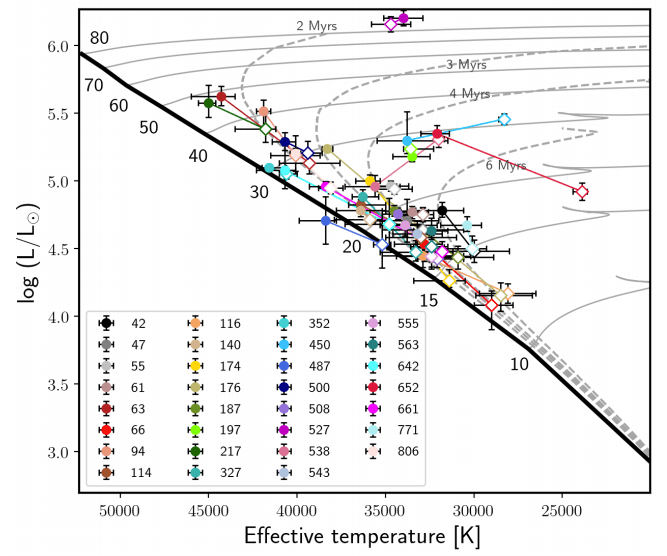
Hertzsprung-Russell diagram for the primaries (filled) and secondaries (open) analysed in this study.

The young massive SMC cluster NGC 330 seen by MUSE. I. Observations and stellar content

Bodensteiner, J.; Sana, H.; Mahy, L.; Patrick, L. R.; de Koter, A.; de Mink, S. E.; Evans, C. J.; Götberg, Y.; Langer, N.; Lennon, D. J.; Schneider, F. R. N.; Tramper, F.

Astronomy & Astrophysics, Volume 634, A51 (2020)

ADS – Journal – arXiv

Abstract

Context. A majority of massive stars are part of binary systems, a large fraction of which will inevitably interact during their lives. Binary-interaction products (BiPs), that is, stars affected by such interaction, are expected to be commonly present in stellar populations. BiPs are thus a crucial ingredient in the understanding of stellar evolution.
Aims: We aim to identify and characterize a statistically significant sample of BiPs by studying clusters of 10 – 40 Myr, an age at which binary population models predict the abundance of BiPs to be highest. One example of such a cluster is NGC 330 in the Small Magellanic Cloud.
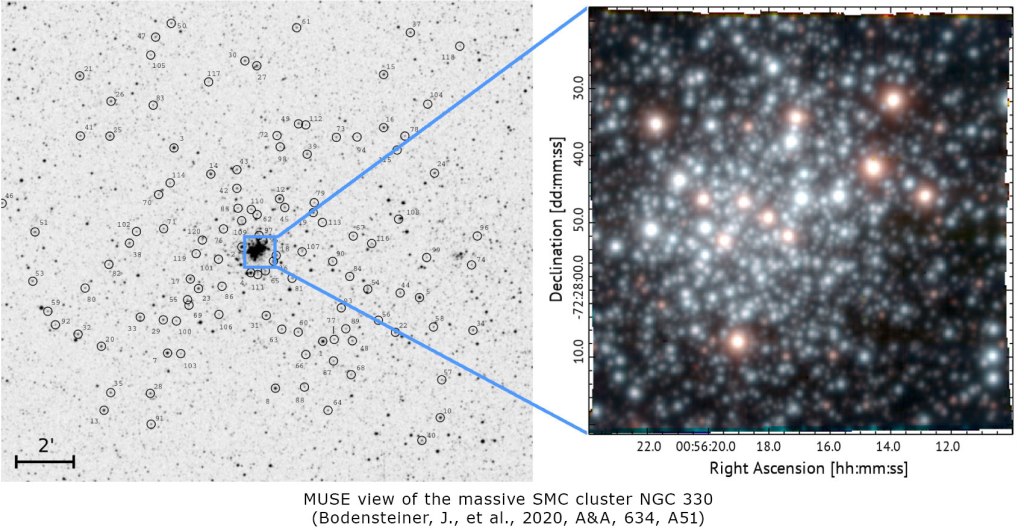
Methods: Using MUSE WFM-AO observations of NGC 330, we resolved the dense cluster core for the first time and were able to extract spectra of its entire massive star population. We developed an automated spectral classification scheme based on the equivalent widths of spectral lines in the red part of the spectrum.
Results: We characterize the massive star content of the core of NGC 330, which contains more than 200 B stars, 2 O stars, 6 A-type supergiants, and 11 red supergiants. We find a lower limit on the Be star fraction of 32 ± 3% in the whole sample. It increases to at least 46 ± 10% when we only consider stars brighter than V = 17 mag. We estimate an age of the cluster core between 35 and 40 Myr and a total cluster mass of 88-18+17 × 103 M.
Conclusions: We find that the population in the cluster core is different than the population in the outskirts: while the stellar content in the core appears to be older than the stars in the outskirts, the Be star fraction and the observed binary fraction are significantly higher. Furthermore, we detect several BiP candidates that will be subject of future studies.

Keywords: stars: massive;stars: emission-line;Be;binaries: spectroscopic;blue stragglers;Magellanic Clouds;open clusters and associations: individual: NGC 330;Astrophysics – Solar and Stellar Astrophysics;Astrophysics – Astrophysics of Galaxies


The ASSESS team

At IAASARS/NOA I am part of the ASSESS project – Episodic MAss LoSS in Evolved MaSsive Stars. This project, funded by an ERC Consolidator grant (2018-2023, PI Bonanos), investigates the impact of episodic mass loss on the evolution of massive stars, and its role in the early Universe. The team is led by dr. Alceste Bonanos, and currently consists of three post-docs (dr. Grigoris Maravelias, dr. Ming Yang, and myself), and one PhD student (Stephan de Wit).

The ASSESS Team (from left to right): Frank Tramper, Grigoris Maravelias, Alceste Bonanos (PI), Ming Yang, and Stephan de Wit.

Artist’s impression of VFTS 352

This animated artist’s impression shows VFTS 352 — the hottest and most massive double star system to date where the two components are in contact and sharing material. The two stars in this extreme system lie about 160 000 light-years from Earth in the Large Magellanic Cloud. This intriguing pair could be heading for a dramatic end, either with the creation of a single monster star or the formation of a binary black hole. Credit: ESO/L. Calçada.

Discovery paperESO press release


Discovery of a Red Supergiant Donor Star in SN2010da/NGC 300 ULX-1

Heida, M.; Lau, R. M.; Davies, B.; Brightman, M.; Fürst, F.; Grefenstette, B. W.; Kennea, J. A.; Tramper, F.; Walton, D. J.; Harrison, F. A.

The Astrophysical Journal Letters, Volume 883, L34 (2019)

ADS – Journal – arXiv

Abstract

SN2010da/NGC 300 ULX-1 was first detected as a supernova impostor in 2010 May and was recently discovered to be a pulsating ultraluminous X-ray source. In this Letter, we present Very Large Telescope/X-shooter spectra of this source obtained in 2018 October, covering the wavelength range 350-2300 nm. The J- and H-bands clearly show the presence of a red supergiant (RSG) donor star that is best matched by a MARCS stellar atmosphere with T eff = 3650-3900 K and log(L bol/L ) = 4.25 ± 0.10, which yields a stellar radius R = 310 ± 70R . To fit the full spectrum, two additional components are required: a blue excess that can be fitted either by a hot blackbody (T ≳ 20,000 K) or a power law (spectral index α ≈ 4) and is likely due to X-ray emission reprocessed in the outer accretion disk or the donor star; and a red excess that is well fitted by a blackbody with a temperature of ̃1100 K, and is likely due to warm dust in the vicinity of SN2010da. The presence of an RSG in this system implies an orbital period of at least 0.8-2.1 yr, assuming Roche-lobe overflow. Given the large donor-to-compact object mass ratio, orbital modulations of the radial velocity of the RSG are likely undetectable. However, the radial velocity amplitude of the neutron star is large enough (up to 40-60 km s-1) to potentially be measured in the future, unless the system is viewed at a very unfavorable inclination.

Keywords: High mass X-ray binary stars;Late-type supergiant stars;Neutron stars;Astrophysics – High Energy Astrophysical Phenomena;Astrophysics – Astrophysics of Galaxies;Astrophysics – Solar and Stellar Astrophysics