Evolved massive stars at low-metallicity. III. A source catalog for the Large Magellanic Cloud

Yang, Ming; Bonanos, Alceste Z.; Jiang, Biwei; Gao, Jian; Gavras, Panagiotis; Maravelias, Grigoris; Wang, Shu; Chen, Xiao-Dian; Lam, Man I.; Ren, Yi; Tramper, Frank; Spetsieri, Zoi T.

Astronomy & Astrophysics, 646, 141 (2021)

ADS – Journal – arXiv

Abstract

We present a clean, magnitude-limited (IRAC1 or WISE1 ≤ 15.0 mag) multiwavelength source catalog for the Large Magellanic Cloud (LMC). The catalog was built by crossmatching (1″) and deblending (3″) between the source list of Spitzer Enhanced Imaging Products and Gaia Data Release 2, with strict constraints on the Gaia astrometric solution in order to remove the foreground contamination. It is estimated that about 99.5% of the targets in our catalog are most likely genuine members of the LMC. The catalog contains 197 004 targets in 52 different bands, including two ultraviolet, 21 optical, and 29 infrared bands. Additional information about radial velocities and spectral and photometric classifications were collected from the literature. We compare our sample with the sample from Gaia Collaboration (2018, A&A, 616, A12), indicating that the bright end of our sample is mostly comprised of blue helium-burning stars (BHeBs) and red HeBs with inevitable contamination of main sequence stars at the blue end. After applying modified magnitude and color cuts based on previous studies, we identified and ranked 2974 red supergiant, 508 yellow supergiant, and 4786 blue supergiant candidates in the LMC in six color-magnitude diagrams (CMDs). The comparison between the CMDs from the two catalogs of the LMC and Small Magellanic Cloud (SMC) indicates that the most distinct difference appears at the bright red end of the optical and near-infrared CMDs, where the cool evolved stars (e.g., red supergiant stars (RSGs), asymptotic giant branch stars, and red giant stars) are located, which is likely due to the effect of metallicity and star formation history. A further quantitative comparison of colors of massive star candidates in equal absolute magnitude bins suggests that there is essentially no difference for the BSG candidates, but a large discrepancy for the RSG candidates since LMC targets are redder than the SMC ones, which may be due to the combined effect of metallicity on both spectral type and mass-loss rate as well as the age effect. The effective temperatures (Teff) of massive star populations are also derived from reddening-free color of (J – KS)0. The Teff ranges are 3500 < Teff < 5000 K for an RSG population, 5000 < Teff < 8000 K for a YSG population, and Teff > 8000 K for a BSG population, with larger uncertainties toward the hotter stars.

Keywords: infrared: stars;Magellanic Clouds;stars: late-type;stars: massive;stars: mass-loss;stars: variables: general;Astrophysics – Solar and Stellar Astrophysics;Astrophysics – Astrophysics of Galaxies
Reconstructing the EUV Spectrum of Star-forming Regions from Millimeter Recombination Lines of H I, He I, and He II

Murchikova, Lena; Murphy, Eric J.; Lis, Dariusz C.; Armus, Lee; de Mink, Selma; Sheth, Kartik; Zakamska, Nadia; Tramper, Frank; Bongiorno, Angela; Elvis, Martin; Kewley, Lisa; Sana, Hugues

The Astrophysical Journal, 903 29 (2020)

ADS – Journal – arXiv

Abstract

The extreme ultraviolet (EUV) spectra of distant star-forming regions cannot be probed directly using either ground- or space-based telescopes due to the high cross section for interaction of EUV photons with the interstellar medium. This makes EUV spectra poorly constrained. The millimeter/submillimeter recombination lines of H and He, which can be observed from the ground, can serve as a reliable probe of the EUV. Here we present a study based on ALMA observations of three Galactic ultracompact H II regions and the starburst region Sgr B2(M), in which we reconstruct the key parameters of the EUV spectra using millimeter recombination lines of H I, He I, and He II. We find that in all cases the EUV spectra between 13.6 and 54.4 eV have similar frequency dependence: ${L}_{\nu }\propto {\nu }^{-4.5\pm 0.4}.$ We compare the inferred values of the EUV spectral slopes with the values expected for a purely single stellar evolution model (Starburst99) and the Binary Population and Spectral Synthesis code (BPASS). We find that the observed spectral slope differs from the model predictions. This may imply that the fraction of interacting binaries in H II regions is substantially lower than assumed in BPASS. The technique demonstrated here allows one to deduce the EUV spectra of star-forming regions, providing critical insight into photon production rates at $\lambda \leqslant 912\mathring{{\rm{A}}}$ , and can serve as calibration to starburst synthesis models, improving our understanding of star formation in the distant universe and the properties of ionizing flux during reionization.

Keywords: Astrophysicists;Interstellar medium;Star-forming regions;Star formation;Radiative recombination;Compact H II region;105;847;1565;1569;2057;286;Astrophysics – Astrophysics of Galaxies;Astrophysics – Solar and Stellar Astrophysics


Evolved massive stars at low metallicity. II. Red supergiant stars in the Small Magellanic Cloud

Yang, Ming; Bonanos, Alceste Z.; Jiang, Bi-Wei; Gao, Jian; Gavras, Panagiotis; Maravelias, Grigoris; Wang, Shu; Chen, Xiao-Dian; Tramper, Frank; Ren, Yi; Spetsieri, Zoi T.; Xue, Meng-Yao

Astronomy & Astrophysics, Volume 639, A116 (2020)

ADS – Journal – arXiv

Abstract

We present the most comprehensive red supergiant (RSG) sample for the Small Magellanic Cloud (SMC) to date, including 1239 RSG candidates. The initial sample was derived based on a source catalog for the SMC with conservative ranking. Additional spectroscopic RSGs were retrieved from the literature, and RSG candidates were selected based on the inspection of Gaia and 2MASS color-magnitude diagrams (CMDs). We estimate that there are in total ∼1800 or more RSGs in the SMC. We purify the sample by studying the infrared CMDs and the variability of the objects, though there is still an ambiguity between asymptotic giant branch stars (AGBs) and RSGs at the red end of our sample. One heavily obscured target was identified based on multiple near-IR and mid-IR (MIR) CMDs. The investigation of color-color diagrams shows that there are fewer RSGs candidates (∼4%) showing PAH emission features compared to the Milky Way and LMC (∼15%). The MIR variability of RSG sample increases with luminosity. We separate the RSG sample into two subsamples (risky and safe), and identify one M5e AGB star in the risky subsample based on simultaneous inspection of variabilities, luminosities, and colors. The degeneracy of mass loss rate (MLR), variability, and luminosity of the RSG sample is discussed, indicating that most of the targets with high variability are also the bright ones with high MLR. Some targets show excessive dust emission, which may be related to previous episodic mass loss events. We also roughly estimate the total gas and dust budget produced by entire RSG population as ∼1.9-1.1+2.4 × 10-6 M yr-1 in the most conservative case, according to the derived MLR from IRAC1-IRAC4 color. Based on the MIST models, we derive a linear relation between Teff and observed J – KS color with reddening correction for the RSG sample. By using a constant bolometric correction and this relation, the Geneva evolutionary model is compared with our RSG sample, showing a good agreement and a lower initial mass limit of ∼7 M for the RSG population. Finally, we compare the RSG sample in the SMC and the LMC. Despite the incompleteness of LMC sample in the faint end, the result indicates that the LMC sample always shows redder color (except for the IRAC1-IRAC2 and WISE1-WISE2 colors due to CO absorption) and higher variability than the SMC sample, which is likely due to a positive relation between MLR, variability and the metallicity.

Keywords: infrared: stars;Magellanic Clouds;stars: late-type;stars: massive;stars: mass-loss;stars: variables: general;Astrophysics – Solar and Stellar Astrophysics;Astrophysics – Astrophysics of Galaxies


Properties of OB star-black hole systems derived from detailed binary evolution models

Langer, N.; Schürmann, C.; Stoll, K.; Marchant, P.; Lennon, D. J.; Mahy, L.; de Mink, S. E.; Quast, M.; Riedel, W.; Sana, H.; Schneider, P.; Schootemeijer, A.; Wang, C.; Almeida, L. A.; Bestenlehner, J. M.; Bodensteiner, J.; Castro, N.; Clark, S.; Crowther, P. A.; Dufton, P. Evans, C. J.; Fossati, L.; Gräfener, G.; Grassitelli, L.; Grin, N.; Hastings, B.; Herrero, A.; de Koter, A.; Menon, A.; Patrick, L.; Puls, J.; Renzo, M.; Sander, A. A. C.; Schneider, F. R. N.; Sen, K.; Shenar, T.; Simón-Días, S.; Tauris, T. M.; Tramper, F.; Vink, J. S.; Xu, X. -T.

Astronomy & Astrophysics, Volume 638, A39 (2020)

ADS – Journal – arXiv

Abstract

Context. The recent gravitational wave measurements have demonstrated the existence of stellar mass black hole binaries. It is essential for our understanding of massive star evolution to identify the contribution of binary evolution to the formation of double black holes.
Aims: A promising way to progress is investigating the progenitors of double black hole systems and comparing predictions with local massive star samples, such as the population in 30 Doradus in the Large Magellanic Cloud (LMC).
Methods: With this purpose in mind, we analysed a large grid of detailed binary evolution models at LMC metallicity with initial primary masses between 10 and 40 M, and identified the model systems that potentially evolve into a binary consisting of a black hole and a massive main-sequence star. We then derived the observable properties of such systems, as well as peculiarities of the OB star component.
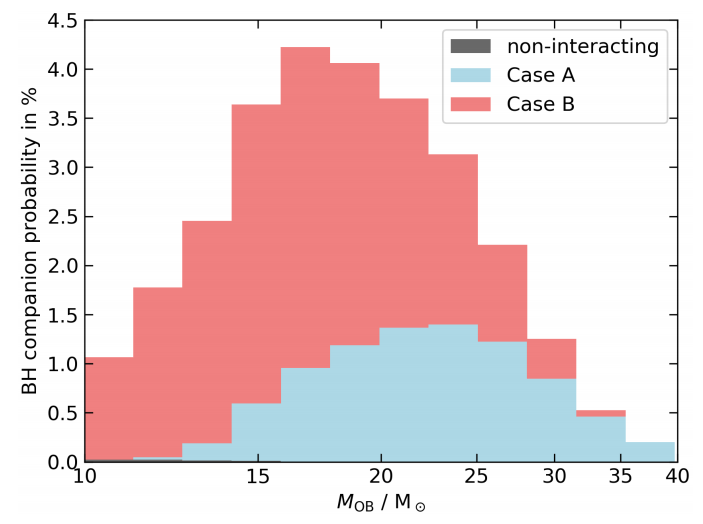
Results: We find that ∼3% of the LMC late-O and early-B stars in binaries are expected to possess a black hole companion when stars with a final helium core mass above 6.6 M are assumed to form black holes. While the vast majority of them may be X-ray quiet, our models suggest that these black holes may be identified in spectroscopic binaries, either by large amplitude radial velocity variations (≳50 km s-1) and simultaneous nitrogen surface enrichment, or through a moderate radial velocity (≳10 km s-1) and simultaneous rapid rotation of the OB star. The predicted mass ratios are such that main-sequence companions can be excluded in most cases. A comparison to the observed OB+WR binaries in the LMC, Be and X-ray binaries, and known massive black hole binaries supports our conclusion.
Conclusions: We expect spectroscopic observations to be able to test key assumptions in our models, with important implications for massive star evolution in general and for the formation of double black hole mergers in particular.

Keywords: stars: evolution;stars: massive;binaries: close;stars: black holes;stars: early-type;stars: rotation;Astrophysics – Solar and Stellar Astrophysics;Astrophysics – High Energy Astrophysical Phenomena


Probability of OB stars of a given mass to have a BH companion as a function of the mass of the OB star, according to our population synthesis model. The initial mass function, initial binary parameter distributions, and the lifetimes of the OB+BH systems have been considered. A initial binary fraction of 100% has been assumed.

The Tarantula Massive Binary Monitoring. IV. Double-lined photometric binaries

Mahy, L.; Almeida, L. A.; Sana, H.; Clark, J. S.; de Koter, A.; de Mink, S. E.; Evans, C. J.; Grin, N. J.; Langer, N.; Moffat, A. F. J.; Schneider, F. R. N.; Shenar, T.; Tramper, F.

Astronomy & Astrophysics, Volume 634, A119 (2020)

ADS – Journal – arXiv

Abstract

Context. A high fraction of massive stars are found to be binaries but only a few of them are reported as photometrically variable. By studying the populations of double-lined spectroscopic binaries in the 30 Doradus region, we found a subset of them that have photometry from the OGLE project and that display variations in their light curves related to orbital motions.
Aims: The goal of this study is to determine the dynamical masses and radii of the 26 binary components in order to investigate the mass-discrepancy problem and to provide an empirical mass-luminosity relation for the Large Magellanic Cloud (LMC).
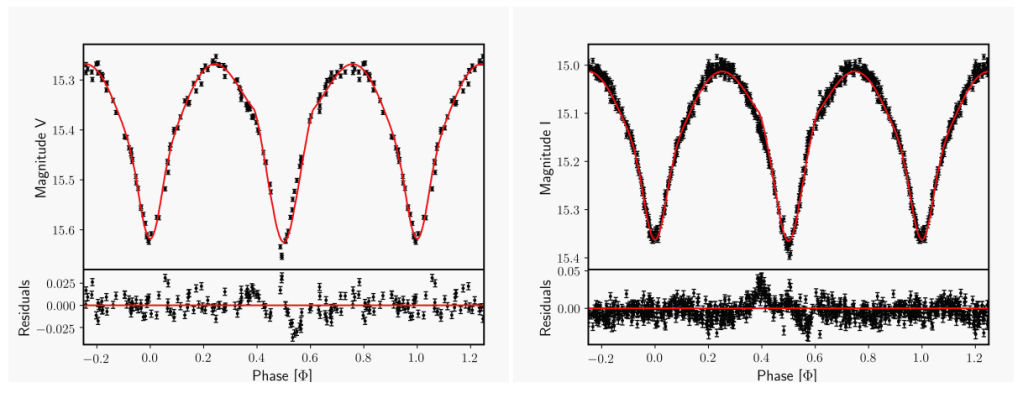
Methods: We use the PHOEBE programme to perform a systematic analysis of the OGLE V and I light curves obtained for 13 binary systems in the 30 Doradus region. We adopt the effective temperatures, and orbital parameters derived previously to obtain the inclinations of the systems and the parameters of the individual components.
Results: Three systems display eclipses in their light curves, while the others only display ellipsoidal variations. We classify two systems as over-contact, five as semi-detached, and four as detached. The two remaining systems have uncertain configurations due to large uncertainties on their inclinations. The fact that systems display ellipsoidal variations has a significant impact on the inclination errors. From the dynamical masses, luminosities, and radii, we provide LMC-based empirical mass-luminosity and mass-radius relations, and we compare them to other relations given for the Galaxy, the LMC, and the Small Magellanic Cloud. These relations differ for different mass ranges, but do not seem to depend on the metallicity regimes. We also compare the dynamical, spectroscopic, and evolutionary masses of the stars in our sample. While the dynamical and spectroscopic masses agree with each other, the evolutionary masses are systematically higher, at least for stars in semi-detached systems. This suggests that the mass discrepancy can be partly explained by past or ongoing interactions between the stars.

Keywords: stars: early-type;binaries: eclipsing;open clusters and associations: individual: 30 Doradus;stars: fundamental parameters;Astrophysics – Solar and Stellar Astrophysics


Best-fit model for the V and I band lightcurves of VFTS 061.